Allocation Planning
In Fashion&Luxury, effective Allocation Planning ensures the right products reach the right stores at the right time. It serves as the operational bridge that translates high-level assortment strategy into precise, store-level distribution, ensuring that inventory is deployed where it generates the highest financial return.

The primary purpose of Allocation Planning is to ensure that fashion brands can align their inventory with real customer demand
In today’s volatile fashion market, inventory is often perceived as a financial risk; however, effective allocation planning transforms it into a primary growth driver. It serves as the vital operational link that translates high-level assortment strategies into precise, store-level execution to ensure the right products reach the right locations at the exact time they are needed
- Allocate stock where it generates the highest financial return, and minimizes lost sales in high-growth areas to drive profitability
- Use AI-driven simulations to optimize dynamic replenishment and inventory rebalancing to react to demand shifts in real-time and reduce inventory risk
How can Stealth Cosmica for Allocation Planning help?

AI-Powered Demand Alignment
Stealth Cosmica aligns inventory with real customer demand by analyzing real-time sales, market signals, and product performance. It provides granular SKU- and store-level insights, ensuring stock is placed where it delivers the highest financial return.

Real-Time Inventory Visibility and Control
Stealth Cosmica gives a unified, real-time view of inventory across warehouses, stores, and in-transit stock, enabling accurate distribution decisions and coordinated global inventory management.

Dynamic In-Season Replenishment and Rebalancing
Stealth Cosmica continuously monitors performance to identify best sellers and underperforming locations in real time. It enables dynamic replenishment and inventory rebalancing, helping brands respond quickly to demand shifts, improve product availability, and minimize excess stock and markdown risk.

Operational Scalability through Automation
The solution leverages automated workflows and configurable optimization algorithms to manage complex distribution at scale. Exception-based allocation handles routine distributions automatically, letting planners focus on anomalies and high-impact strategic decisions.
How Stealth Cosmica works For Allocation Planning?
Allocation planning begins with defining objectives aligned with merchandising strategy, financial targets, and channel priorities. Store segmentation and allocation rules establish the decision framework.
Forecasted demand, historical performance, and store capacity are analyzed to determine each location’s sales potential and inventory needs.
Inventory quantities are calculated at SKU and store level to support launches and seasonal plans, ensuring optimal product availability from the start.
Products are distributed across stores and channels based on allocation logic, operational constraints, and delivery schedules. Automated workflows and real-time inventory visibility ensure accurate execution, reducing manual effort and improving distribution efficiency across the retail network.
By monitoring real-time sales and store performance, it dynamically replenishes high-demand locations and redistributes stock from slower-moving areas, maximizing product availability and minimizing excess inventory.
Allocation outcomes are analyzed to refine allocation parameters, improve forecasting accuracy, and enhance future distribution strategies. Data-driven insights and AI-powered recommendations support continuous optimization of inventory productivity and financial performance.
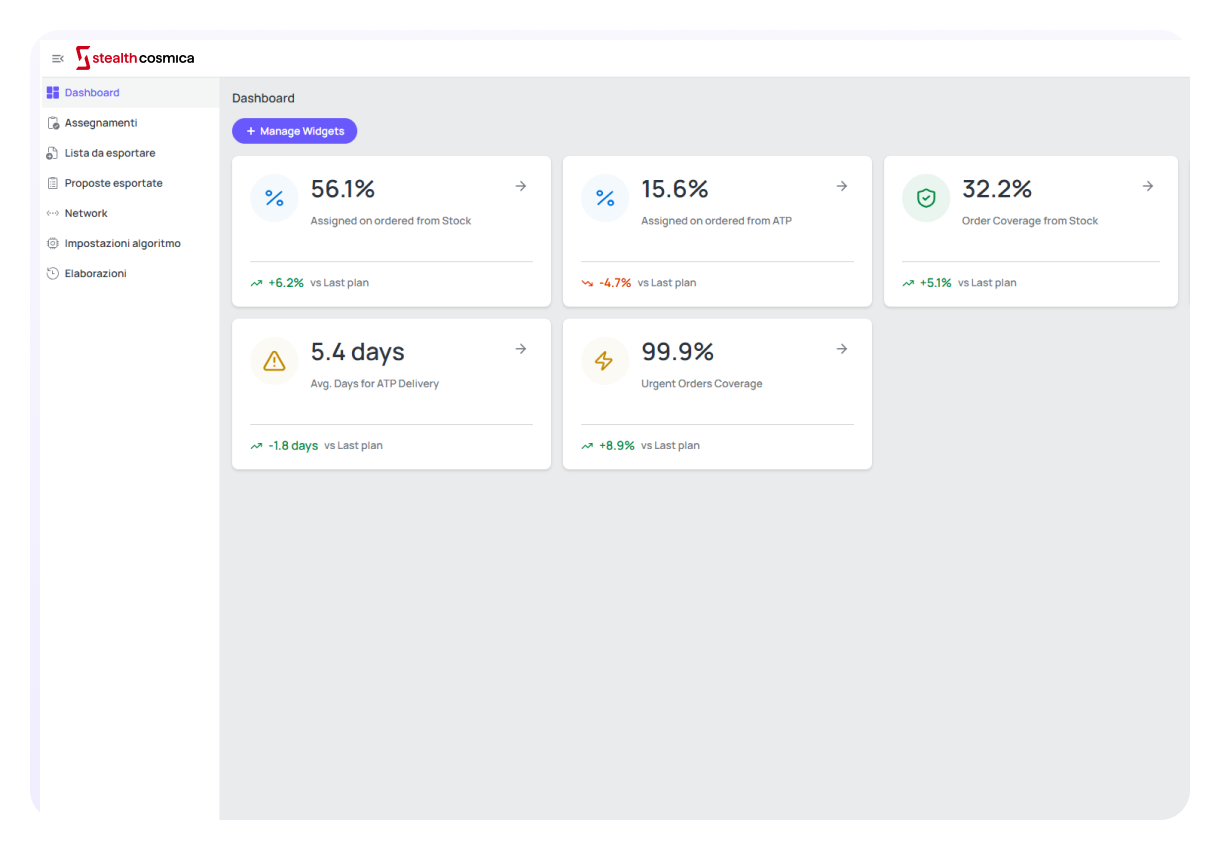
Outcomes

Faster Response to Demand Shifts
By making allocation planning a continuous process rather than a one-time event, Stealth Cosmica allows retailers to monitor sell-through in real-time. This responsiveness enables the system to trigger the replenishment of top-performing stores and the reallocation of slow-moving inventory, ensuring the brand can react quickly to changing consumer trends throughout the season.
Increased Operational Efficiency and Scalability
Stealth Cosmica utilizes automated, exception-based workflows that handle routine distributions without manual intervention. This significantly reduces manual effort across the retail network and allows expert planners to focus their attention on anomalies and high-impact strategic decisions, enhancing the brand’s ability to scale operations.


Continuous Improvement of Distribution Strategies
Stealth Cosmica analyzes allocation outcomes to provide data-driven insights that refine future allocation parameters. This feedback loop improves forecasting accuracy and enhances future distribution strategies, ensuring that inventory productivity and financial performance are constantly optimized based on previous performance data.
Reduced Stock Imbalance
Through AI-driven intelligence and granular SKU-level insights, Stealth Cosmica minimizes overstock in low-performing locations while preventing stock-outs in high-demand stores. This balanced distribution ensures optimal product availability across the entire retail network from the start of the season

Who is Stealth Cosmica for Allocation Planning for?

Retail Manager
Supply Chain and Logistics Manager
Omnichannel Planner
Resources Manager
Frequently Asked Questions
The core purpose of allocation planning is to ensure that the right products reach the right stores at the right time. It acts as the operational bridge that translates a high-level assortment strategy into precise, store-level distribution, which maximizes sell-through and reduces costly stock imbalances
The solution utilizes advanced AI-driven intelligence to align inventory with real-time customer demand. By analyzing real-time sales data, market signals, and product performance at the SKU and store level, it ensures stock is placed where it generates the highest financial return, minimizing both lost sales and excess inventory.
By making data-driven distribution decisions, brands can maximize full-price sell-through and increase inventory turnover. . This directly protects profit margins by reducing the need for end-of-season markdowns and ensuring that inventory investment is always focused on the areas of highest demand.
Working with a global network of international Partners