Merchandise Financial Planning
Merchandise Financial Planning serves as a strategic bridge connecting product strategy, financial planning, and operational execution. Its primary objective is to ensure that a brand delivers the right product mix, in the right quantities, at the right time, across all global channels. By integrating financial targets with assortment strategies, Fashion &Luxury companies can maintain consistency across markets while maximizing profitability.

An effective Merchandise Financial Planning strategy provides a single source of truth for finance, merchandising, and supply chain teams
In the fast-paced fashion and luxury market, where consumer tastes shift quickly and product lifecycles are increasingly short, brands must make every buying decision count. Merchandise Financial Planning serves as the strategic framework that links these day-to-day inventory and assortment choices directly to overarching revenue and margin goals:
- Reduce revenue loss from inaccurate forecasts, inventory misalignment, and heavy markdowns, while navigating market volatility, supply chain disruptions, and inflationary pressures through data-driven decisions
- allocate inventory across omnichannel platforms, break down departmental silos, and leverage real-time monitoring and Open-To-Buy management to increase agility, maximize margins, and respond quickly to changing demand
How can Stealth Cosmica for Merchandise Financial Planning help?

Enhanced Forecast Accuracy and Decision-Making
Merchandise Financial Planning leverages real-time data and AI-driven forecasting to improve accuracy and reduce reliance on intuition. With Stealth Cosmica, brands can make faster, data-driven decisions, aligning product launches with demand and optimizing inventory and assortment strategies.

Inventory Optimization and Reduced Waste
With Stealth Cosmica, stock levels are optimized across the entire retail network, reducing excess inventory and minimizing waste. It enables active Open-To-Buy management, allowing planners to compare real-time performance against forecasts and adjust budgets, reallocate stock, or cancel orders mid-season to prevent overstocking.

Organizational Alignment and Strategic Agility
MFP creates a single source of truth, breaking down silos across finance, merchandising, and supply chain teams to align on shared KPIs. Combined with scenario modeling, it enables brands to stay agile and quickly adapt strategies to market volatility and shifting consumer demand.

Maximized Profit Potential and Margin Protection
MFP ensures inventory is strategically allocated to maximize margins while managing financial risk. By closely aligning supply with demand, it reduces misalignment that can erode 2–5% of revenue through end-of-season markdowns.
How Stealth Cosmica works For Merchandise Fanancial Planning?
Merchandising planning starts with analyzing past sales performance, inventory behavior, and margins, combined with an understanding of market trends and consumer demand. This provides a clear view of what drives results and where improvements are needed.
Based on real-time insights, brands define sales, margin, and inventory targets aligned with overall business strategy. Clear objectives guide all subsequent merchandising decisions.
Sales forecasting estimates future demand by season, category, channel, and market, using historical data and predictive insights. It establishes the demand baseline for planning.
Open-To-Buy planning defines how much inventory can be purchased and when, balancing forecasted sales, existing stock, and financial constraints to maintain flexibility and control.
Assortment planning translates strategy into a structured product mix, defining the number of styles, depth, and price architecture to meet customer demand and profitability goals.
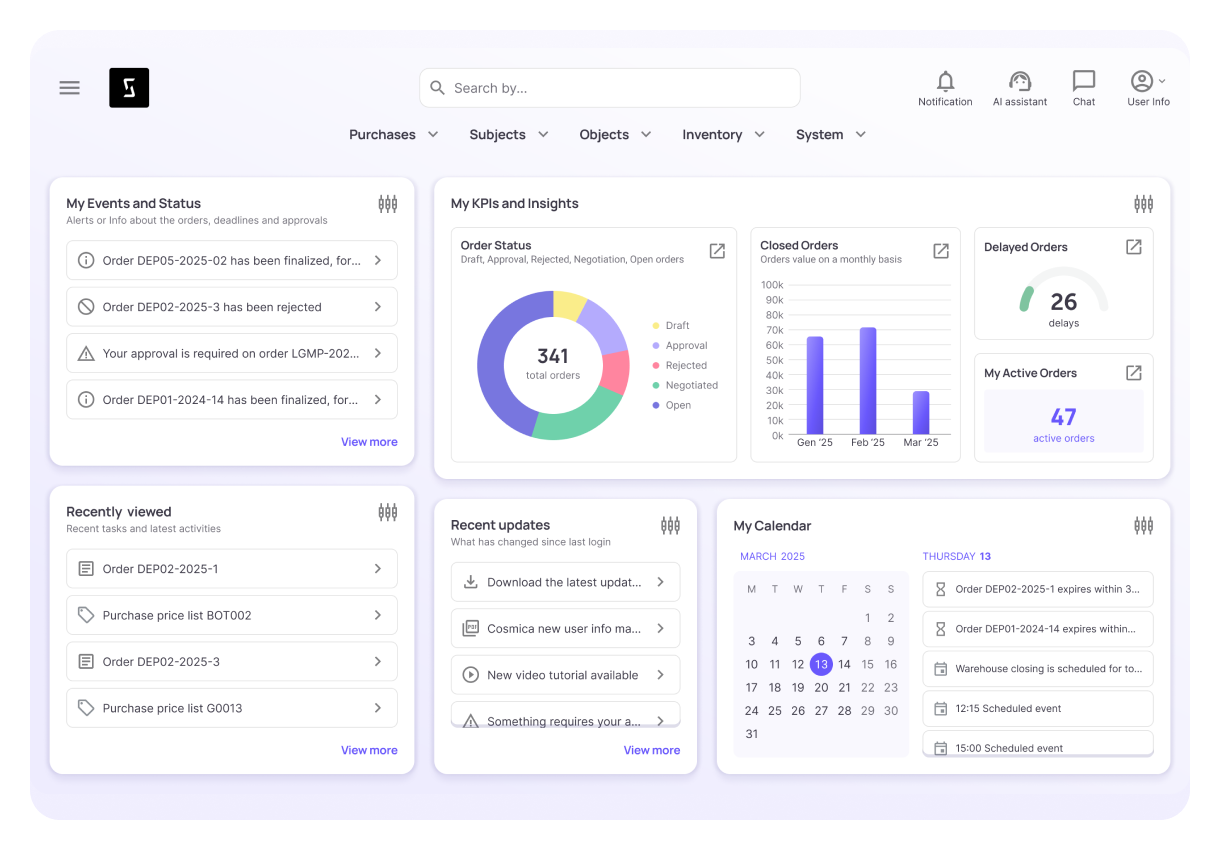
Outcomes

Minimized Loss from Markdowns and Promotions
A strong Merchandise Financial Planning approach prevents inventory misalignment, reducing the need for heavy markdowns that erode revenue. By enabling proactive planning, it ensures products are promoted at the right time to maximize margins rather than reacting to excess stock.
Increased Operational Efficiency
By moving away from manual, error-prone spreadsheets, Stealth Cosmica streamlines planning processes and reduces manual effort, enabling teams to focus on high-impact strategic decisions rather than operational tasks.


Drive cross-functional alignment and accountability
Acting as a single source of truth, Stealth Cosmica aligns finance, merchandising, and supply chain teams around shared KPIs, eliminating silos and ensuring consistent execution against revenue and margin objectives.
Reduced Stock Imbalance
With Stealth Cosmica, retailers can drive efficient stock movement and increase turnover by aligning inventory with real demand. By monitoring in-season sell-through, it enables planners to accelerate or delay purchases, keeping assortments fresh and optimized for what is actually selling.

Who is Stealth Cosmica for Merchandise Financial Planning for?

Merchandising Planner & Manager
Finance Teams
Store Operations Manager
Allocation Teams
Frequently Asked Questions
MFP is the process of aligning high-level financial goals, like revenue, margin, and profitability, with strategic inventory decisions. It helps answer key questions such as which products to purchase at the SKU level, where to sell them across different channels, and the best timing to bring them to market in order to maximize demand.
AI-driven solutions like Stealth Cosmica rely on demand intelligence to analyze consumer behavior, market trends, and inventory needs. This technology enables smarter, faster decision-making by providing real-time insights, reducing uncertainty through predictive analytics, and minimizing forecasting errors.
Granular planning allows retailers to make decisions at the most detailed level. By calculating OTB quantities for specific SKU-location combinations, brands can improve product availability and optimize size distributions while simultaneously reducing excess stock and waste across the retail network.
Retailers often struggle when they rely on manual spreadsheets, which are slow and error-prone, or when they operate in silos, leading to misaligned priorities between finance and merchandising. Other critical errors include ignoring in-season trends by failing to course-correct mid-season and failing to integrate multiple channels.
Working with a global network of international Partners