Master Production Schedule (MPS) & Material Requirements Planning (MRP)
Efficient Master Production Schedule (MPS) and Material Requirements Planning (MRP) management provide fashion brands with the agility needed to navigate rapid shifts in consumer demand and seasonal trends. By transitioning from reactive to proactive, data-driven planning, the solution enhances profitability and operational efficiency in several key ways.

Effective MRP and MPS Management Is the Foundation of Precision-Driven Production
Today’s fashion market is defined by speed, volatility, and constant change. Consumer demand is increasingly influenced by digital channels, social media trends, and seasonal dips, forcing brands to respond faster than ever while maintaining efficiency and profitability.
In this environment, traditional, reactive planning is no longer sufficient. Fashion brands must adopt structured, data-driven approaches that align demand with production in real time. Effective management of Master Production Scheduling (MPS) and Material Requirements Planning (MRP) enables this shift, transforming fragmented demand signals into coordinated production and procurement strategies.
- Collect precise data from demand forecasts, current inventory, lead times, and capacity constraints to generate a detailed production timetable
- Create a coherent and realistic Production Plan by accounting for finite resource capacity and synchronizing the arrival of critical materials, reducing bottlenecks
How can Stealth Cosmica for MPS and MRP help?

Advanced Planning & AI Optimization
Stealth Cosmica generates a Master Production Schedule (MPS) by combining consolidated order portfolios with sales forecasts using AI-driven optimization algorithms. Inputs are transformed into a coherent, realistic, and sustainable plan by accounting for real-world constraints like plant capacity, supplier punctuality, and resource saturation.

Feasibility & Constraint Management
Stealth Cosmica provides deep visibility into material coverage, distinguishing between stock, released orders, and planned orders. It calculates critical indicators like “Launchable” (materials for the first phase are available) and “Completable” (all materials for the cycle are ready), ensuring production only starts when feasible.

Proactive “What-if” Simulations
With Stealth Cosmica, brands can perform scenario analysis to evaluate the impact of different operational choices before finalizing a plan. This includes simulating changes to supplier lead times, resource calendars, or order priorities, allowing the company to choose the scenario that best balances service levels (punctuality) with production efficiency (saturation).

Streamlined Execution & Monitoring
The system provides a centralized dashboard to monitor real-time KPIs, such as resource underutilization or bottleneck risks. Once a plan is validated, it generates purchase and production proposals that can be grouped into “packages” and pushed directly to the ERP system for immediate action.
How Stealth Cosmica Works For
MPS and MRP?
Stealth Cosmica utilizes optimization algorithms and Artificial Intelligence to create a coherent, realistic, and sustainable production and procurement plan. It bridges the gap between high-level sales forecasts and operational execution by aligning production with real-world constraints
Stealth Cosmica allows brands to calculate actual supplier punctuality, safety stock levels, and lead times to provide more accurate information to the planner.
Brands can configure the “Objective Function” to reflect business priorities, such as finding the optimal trade-off between customer service (punctuality) and production efficiency (resource saturation)
Planners can set a fixed or rolling planning horizon (e.g., 52 weeks) with a “fencing” window to freeze imminent operational periods for stability while optimizing the medium term.
Unlike infinite planning, Stealth Cosmica allows to account for real-world bottlenecks, identifying resource overloads or underuse. It allows for “What-if” simulations where planners can test changes to resource calendars or order priorities before releasing the final plan.
The system calculates a delay index for every production order, allowing planners to prioritize the most critical tasks.
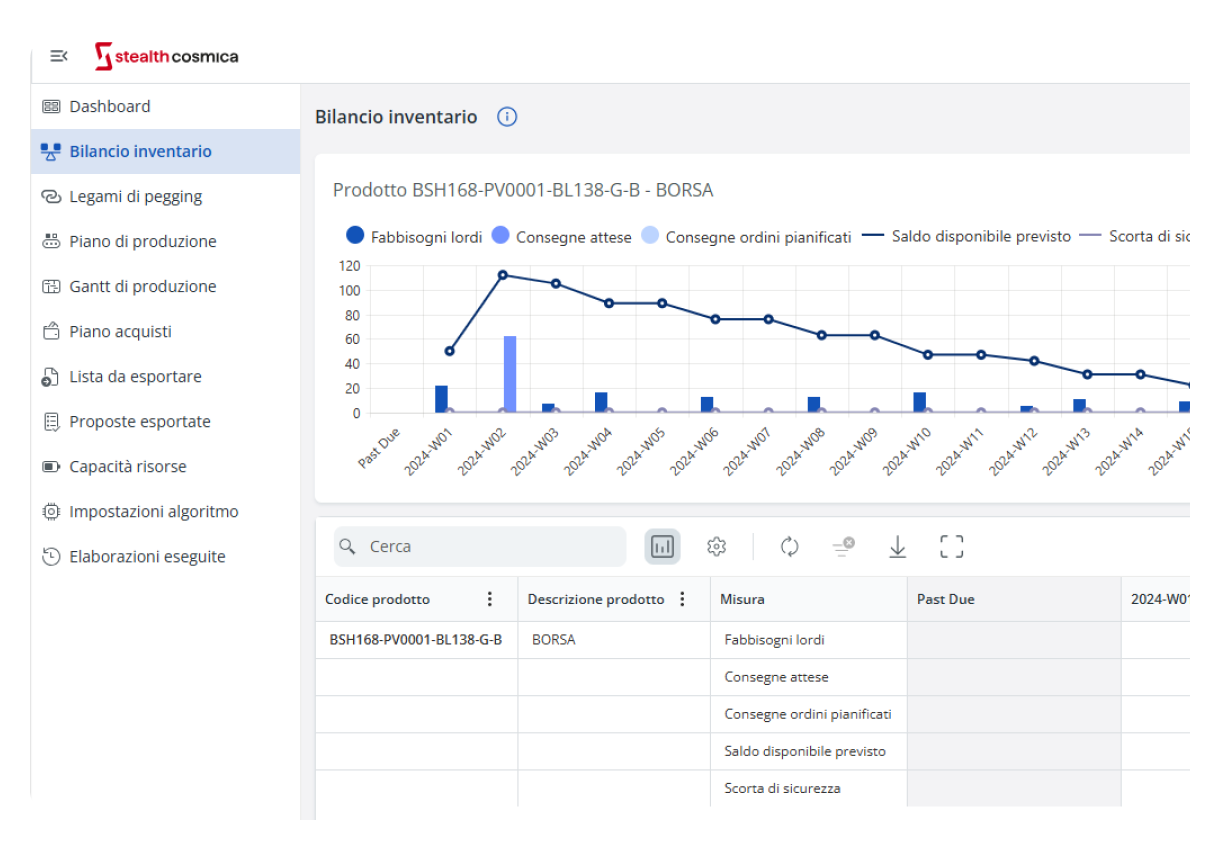
A primary view highlights operational priorities, resource loads, and inventory projections over time.
Plans can be segmented by specific attributes such as season (e.g., Spring/Summer), production division, or process type.
Outcomes

Inventory Cost Reduction and Waste Minimization
Through effective MPS and MRP management, Stealth Cosmica enables alignment of production with real-time demand signals, reducing excess inventory, markdowns, and obsolete stock. This ensures resources are used efficiently while minimizing financial losses from overproduction.
Operational Agility and Responsiveness
Stealth Cosmica supports agile planning, enabling fashion brands to respond quickly to shifting trends, seasonal changes, and unexpected demand fluctuations. This flexibility provides a competitive edge in the fast-moving fashion industry


Synchronized Procurement
With Stealth Cosmica, MRP management ensures that material arrival is synchronized with the production cycle. This allows the purchasing office to intervene only on truly critical materials, avoiding unnecessary follow-ups and ensuring orders are “launchable” on time
Data-Driven Decision Making
Using advanced tools allows for “What-if” simulations, enabling planners to evaluate the impact of different operational choices, such as changing a supplier or adjusting a calendar, before finalized production and purchase proposals are released.

Who is Stealth Cosmica for MPS and MRP for?

Manufacturing Manager & Director
Production Planners
Purchasing Manager
Inventory Manager
Frequently Asked Questions
A sales forecast is an estimate of future customer demand based on historical data and market trends. In contrast, the Master Production Schedule translates that forecast into a detailed operational plan specifying exactly when and how much of each product to produce, while accounting for real-world constraints like production capacity and inventory levels.
Traditional systems often rely on static historical data, but Stealth Cosmica uses Machine Learning to estimate dynamic parameters. This includes more accurate calculations for actual supplier punctuality, safety stock levels, and lead times, providing planners with higher-quality information to make better operational decisions.
Yes, the system allows for “What-if” simulations where planners can create alternative versions of a plan. You can vary parameters such as resource capacity, supplier assignments, or material delivery dates to compare different scenarios and evaluate their impact on business goals like punctuality and resource saturation before releasing the definitive plan.
A fencing window is a specific period in the planning horizon that is “frozen” to ensure stability. By freezing imminent operational periods, the brand prevents constant, disruptive changes to the immediate production schedule while still allowing for optimization and flexibility in the medium-to-long term.
To maintain agility and respond to fluctuating demand, it is considered best practice to review and update the MPS regularly, typically on a weekly or biweekly basis. This allows the brand to incorporate the latest sales data, marketing attribution insights, and any sudden changes in the supply chain.
Working with a global network of international Partners