Replenishment
In a context defined by demand volatility, short product lifecycles, and increasing pressure on margins, Replenishment has become a critical capability. Reacting in real time is now essential: rather than relying on large upfront production and reactive discounting, leading brands need to shift toward more agile models, where Replenishment decisions are continuously optimized based on actual performance.

Managing Replenishment effectively means implementing a structured, systemic process to monitor and restore inventory across all sales channels
Effective replenishment is adelicate balance between meeting consumer demand and optimizing inventory costs to avoid the twin pitfalls of stockouts and overstocking. However, it is not an isolated task; it must be closely linked to the seasonal buy and initial allocation.
- Fashion trends and demand vary by climate, culture, and demographics, so stock must be allocated and replenished based on the unique sales patterns of individual locations rather than a “one-size-fits-all” approach
- Automated systems reduce human error, speed up restocking times, and provide real-time visibility across omnichannel networks, allowing retailers to fulfill demand from warehouses or nearby stores if a specific location is out of stock
How can Stealth Cosmica for Replenishment help?

Managing High SKU Complexity
AI-driven replenishment tools like Stealth Cosmica allow brands to accurately predict demand for thousands of SKUs across multiple countries and channels, a task that is virtually impossible to manage manually via spreadsheets.

Optimizing Working Capital and Costs:
By maintaining leaner operations and avoiding overstocking, brands can reduce the amount of capital tied up in inventory. With Stealth Cosmica, they can also cut down on operational and holding costs by ensuring only necessary inventory is stored.

Mitigating the Risks of “Seasonal Buys”
Fashion retailers often commit to purchases 3–6 months in advance. Replenishment acts as a safety net, allowing brands to be flexible by using real-time sales data to scale up on successful products and pull back on underperforming ones as the season progresses.

Maximizing Sales and Preventing Lost Opportunities
The primary goal for Retailers is to ensure sales continuity by keeping products on the shelves. By aiming for a high in-stock rate, brands can take advantage of Stealth Cosmica to ensure customers find what they need, which directly prevents the lost revenue and damaged loyalty associated with stockouts.
How Stealth Cosmica Works For Replenishment?
Effective replenishment is the backbone of successful fashion retail, ensuring that the right products are always available when and where customers need them. By minimizing stockouts and avoiding excess inventory, brands can protect margins while maximizing sales opportunities. A smart, data-driven approach improves cash flow, streamlines operations, and enables faster reactions to ever-changing trends. With Stealth Cosmica, Replenishment becomes even more powerful, leveraging real-time insights and automation to optimize inventory across channels with precision.
Starting from the allocation plan and available budget, and accounting for supplier lead times, the system calculates the optimal initial quantities to distribute by product and store at the beginning of the selling period or season. This applies to both fashion items and new Never-Out-of-Stock (NOOS) products, with the option to incorporate store clustering insights to further refine distribution and ensure the right assortment reaches the right locations from day one.
Considering available inventory, actual and forecasted sales, and expected lead times, the system recommends the optimal quantities to be sent to each store on a daily or weekly basis throughout the season.
Based on available inventory, actual sales performance, and forecasted demand, the system recommends optimal stock transfers between stores to better balance inventory and meet demand across locations.
The system recommends the optimal quantities to transfer back from stores to the warehouse. This is particularly useful for managing demand peaks across different channels, such as e-commerce.
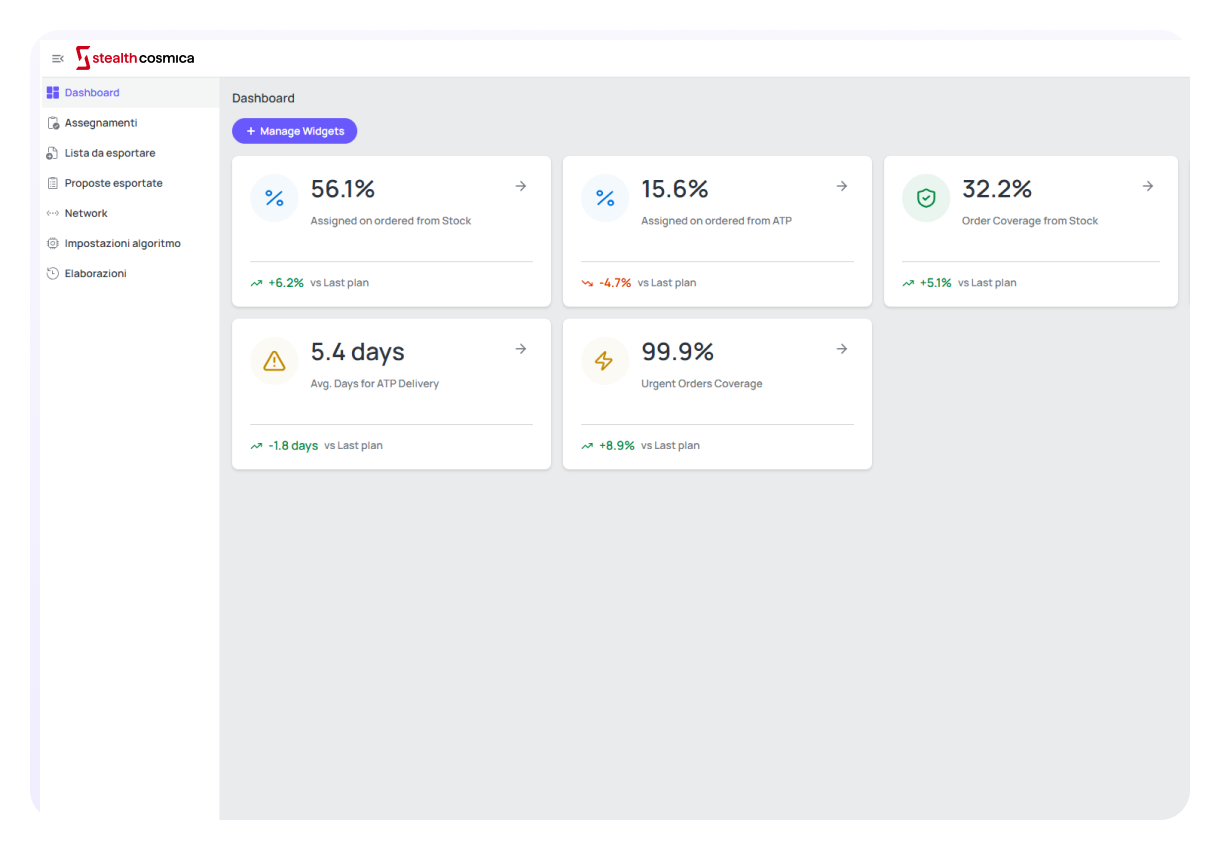
Outcomes

Increased Sales and fewer Stockouts
Products are consistently available in the right sizes, colors, and locations. This reduces lost sales caused by out-of-stock situations and ensures customers can always find what they are looking for, leading to higher conversion rates and full-price sell-through.
Healthier Inventory Optimization Levels
Replenishment helps maintain a balanced stock across stores and channels by aligning supply with actual demand. This prevents both overstocking (which ties up capital) and understocking (which leads to missed opportunities), resulting in a healthier and more efficient inventory structure.


Improved profitability and reduced markdowns
By avoiding excess inventory and better managing product flow throughout the season, retailers can reduce the need for discounts and end-of-season markdowns, protecting margins and improving overall profitability.
Stronger Omnichannel performance and Customer Experience
Inventory can be dynamically allocated across stores and e-commerce to meet demand peaks in different channels. This ensures consistent availability, faster fulfillment, and a smoother shopping experience, ultimately increasing customer satisfaction and loyalty.

Who is Stealth Cosmica for Replenishment?

Retailers
E-commerce Manager
Wholesalers & Distributors
Manufacturers
Frequently Asked Questions
The system uses a dual time-horizon logic. It calculates a shorter-time-horizon quantity to cover immediate demand and prevent out-of-stock scenarios. Simultaneously, it calculates a longer-time-horizon quantity that is 99% likely to be sold within a broader window, which minimizes end-of-season leftovers and recall costs.
Yes. The system utilizes a dual approach featuring a simulation environment and a production environment. Planners use a web application to analyze “Unconstrained Allocation Proposals” and apply specific parameters (like warehouse capacity or size constraints) to generate “Constrained Proposals”. Planners can then manually adjust and validate these suggestions before they are sent to the ERP for execution.
The system manages the entire product lifecycle through four key processes: Initial Push (suggestion of starting quantities for stores based on assortment plans and budgets), Reshuffle (Proposes moving stock between stores to balance supply and demand), Replenishment (it calculates daily or weekly needs based on actual sales, forecasts, and lead times), Recall (identification of the optimal stock to return to the central warehouse to satisfy other channels like e-commerce).
Working with a global network of international Partners